“If you learn something new while we walk together, it is from me and it is true.”
The hike out of the canyon from Raven Fork is two miles in a steady uphill climb. Being surprised by the presence of the Creator was something I was still dealing with. The emotions were palpable and elements of the Creation stood out in ways that seemed to join in the conversation. I was worried that when I needed to make a recording of a stream crossing, my attention would focus on the human routines I brought with me into the wilderness but for some reason, this did not happen. The Creator seemed to be at home in the Creation, sharing the joy of it and in return the Creation responded with exuberance and enthusiasm. I came here as an invited guest but that feeling gave way to belonging. Time and mileage became simple tasks when necessary but otherwise slid into the subconscious as they passed quietly, unnoticed.
Then came Enloe Creek.
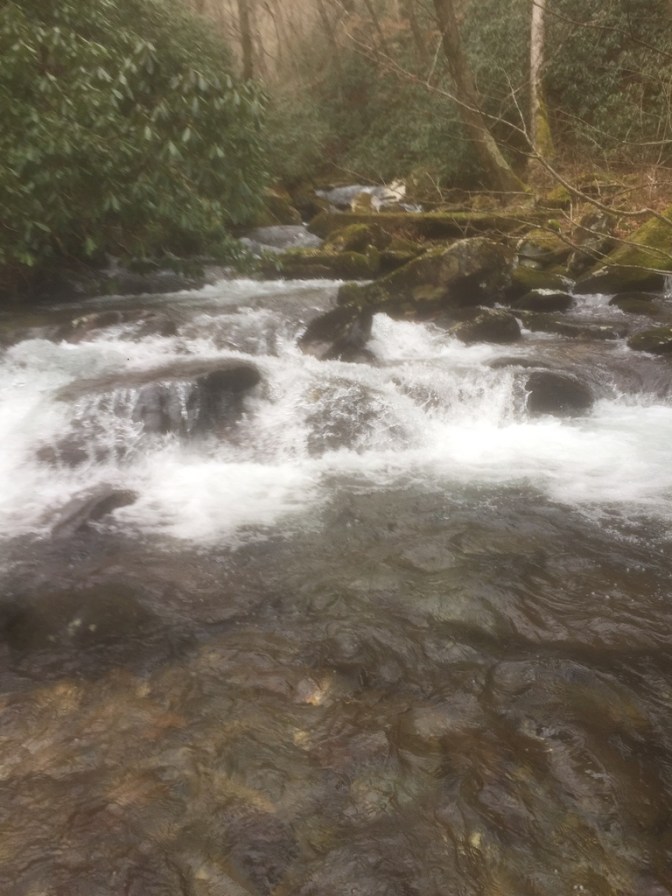
Water in the Smokies is abundant and for the most part, a hiker can travel while keeping dry feet. But once in a while, the crossing involves a walk through the water and one’s boots, waterproof or not, succumb to a cold invasion leaving wet socks. The alternative is to change to sandals to cover 20 feet of trail and then changing back. Many are comfortable with this routine… as long as you know to pack sandals. For the 900 Miler, there are some trails where the wet crossings are so numerous, the changing routine becomes unacceptably onerous. In coming to terms with this reality, I simply plan on getting my feet wet by choosing footwear that easily drains and socks that are thin and dry quickly. In the summer, this is actually a pleasant experience, cooling and refreshing my hot tired feet but in the winter, it remains that I have a hatred of getting my feet wet. By definition the ford at Enloe Creek meant wet feet. But when your hiking companion is the one who built the place, you get a sense of intention and that nothing is there for a reason that isn’t perfect. There is also the awareness that you are a part of it all, integrated into the experience as well as the environment itself. Walking through the knee deep creek seemed as natural and effortless as if it were not there at all, without resentment. without discomfort.
And the conversations continued…
A concern from the beginning of this project is exactly how to tie the things I am learning and experiencing back to scriptures and traditions . Perhaps it’s my way of finding legitimacy and acceptance, or perhaps to stand up to scrutiny. The researcher in me feels the need to maintain some level of academic integrity, referencing everything back to expert theologians or the traditions in which I was raised. Yet the dilemma is that sometimes these insights do not tie neatly back to lessons learned in Sunday School or the statements of faith adopted by organized religion. Simply put, most western religious doctrines have little to say about the place of humans within the creation, the value of our natural wonders, or for that matter, the true practice of Sabbath. Many western perspectives that do articulate the place of humans are from what theologians called anthropocentric, meaning the view that mankind is at the center of creation rather than a part of the continuing process of creation. This was on my mind during the conversations taking place on this hike. The response offered to me was to no surprise, simple and clear.
The scriptures are like a map. When drawn, a map represents the best knowledge about the landscape that is known at that moment, using the existing technology of the day and the experience of the cartographer. Landscapes change over time and new information and technology improves detail and resolution. New experiences and perspectives inform the information available and newer maps more accurately express the landscape as it exists in that moment. The development of western Protestantism is an example of a newly drawn map based on the original scriptures seen through the lens of a contemporary culture and applied to the people of the day. Subsequent splits and myriad denominations evolved from certain groups interpreting scriptures unique to their points of view.
“My prophets were not worried about theology, nor should you be.”
The second blessing was the following insight, put into words, “if you learn something new while we walk together, it is from me and it is true. It is a gift to you for you to share. My prophets were not worried about theology or doctrine, only the truth. So should you be.”
To be still, to cherish, to be grateful…

Copyright 2020 by Shawn A. Carson


