Ever since I became a college professor, I have been using the Compass metaphor often in the lectures I present to my classes. I like the image for several reasons. First, as a Boy Scout, I found the activity of orienteering fascinating. Using a compass and a map, one has to navigate a route, usually around certain obstacles like lakes or large rocks. It is the map that shows you where to go but it is the compass that orients the map to magnetic north, allowing you to look toward the horizon for the landmarks necessary to pursue your destination. The art of orienteering, like many other things, has become antiquated with the dawn of internet based technologies.
A second reason I am drawn to the compass is the craftsmanship that goes into a good device. Its simplicity is intriguing really, a polarized strip of metal that orients to magnetic north when suspended frictionless. I have a small collection including the functional devices I use outdoors, several small pocket compasses collected as symbols, and a brass mariner’s compass in a nice teak box I keep on my desk.
“All I can do is teach you how to use a compass. The rest you have to figure out.”
A third reason is that the metaphor works well in the style of teaching I employ. When teaching entrepreneurship, there is no checklist of tasks that lead to a successful company. One must head down a path that inevitably leads to a barrier. At that point, the entrepreneur must check out the reality of the situation, learn from failed experiences, and decide to stay on that path or reorient, perhaps in a different direction. I tell students that we have gotten used to the accuracy of specific directions provided us by the GPS app on our mobile devices, much like our educational system is based on a set of measurable learning outcomes that students have come to expect as a pathway to success. I cannot give that detailed set of directions that will land you to the destination of success and wealth. All I can do is teach you how to use a compass. The rest you have to figure out.
I have found this sentiment useful, not only in teaching Boy Scouts and MBA’s, but in this WildSabbath journey as well. In Faith After Doubt, Brian McLaren shares a framework for how our faith develops through stages, starting with Simplicity, moving to Complexity, Perplexity and finally to Harmony. The Perplexity stage renders one vulnerable when you realize that the organized religion of your childhood may present challenges that are not easily reconciled with what you may be experiencing. The reasons for this are fodder for many future WildSabbath posts but for now, let’s say that the path through Perplexity on the way to Harmony does not always have a map. You have to get out there, in the Stillness and Solitude often with just a compass. You have to make your path as you re-establish your relationship with the Creator and Creation. So for this reason, I’d like to offer you a compass and teach you how to use it.
“I’d like to offer you a compass and teach you how to use it.”
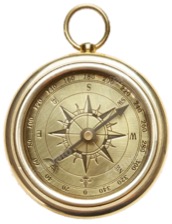
I don’t know exactly when I came across the Moral Compass as a metaphor. It became popular in the 1990’s amidst a number of best sellers on leadership. An internet search placed its origin with Charles Dickens, according to the Oxford Dictionary. I was profoundly influenced by the works of Steven Covey, to whom the quote, “Live your life by a compass, not a clock.” is attributed.
There is an argument among moral relativists that there is no universal set of moral values, therefor the metaphor of the moral compass has no relevance in discussions of morality. Certainly, the stark division of political, religious, and cultural perspectives in our own modern society supports this viewpoint. I want to be clear that in my presentation, the sense of one’s moral compass is deeply personal and is a process, not an end product. I love the short article by Gene Kamena, “Calibrating Your Moral Compass.” Kamena reminds us that a physical compass is subject to interference and requires “periodic calibration,” and so is the case of a person’s moral compass. I stand by my use of it.
“Live your life by a compass, not a clock” – Steven Covey
The metaphor leads directly to the discussion of core values. In fact, some have tried to suggest a person’s core values should be limited to four, corresponding to each of the four coordinates of the compass. The argument favoring this idea is that if you have any more than three or four priorities, then you have none. In personal practice, I believe the process of narrowing down a set of core values to a minimum is a vital exercise. The personal debate over which are most important is a necessary and iterative practice. But I have found four to be too limiting.
The teaching of business strategy always begins with vision, mission, values. Vision is a view of a future state or destination, in line with Covey’s 2nd habit of “Begin with the End in Mind.” Mission is a statement of the purpose of the organization and why it should consume resources. But it is the values of the organization that define its essence. Jim Collins’ take on all this is presented in the book he wrote with Jerry Porras called Built To Last. Visionary organizations (and people) develop a Core Ideology, which is the combination of a Purpose and a set of Core Values. Purpose is an organization’s fundamental reason for existence, a “perpetual star on the horizon.” Kinda like a compass, no? Core Values are contained in a small set of guiding principles. These principles are carefully considered and do not easily change in light of trends and fads of society. The central idea of core values is to provide a framework by which decisions are made, especially the difficult ones that arise in stressful situations, or when beliefs are challenged. Like the calibration of the compass, core values should be reviewed regularly and revised only when a new insight is either gained or revealed.
It is not difficult to see the cross-over between Covey’s perspective on personal development and Collins’ approach to visionary organizations. In presenting these ideas to graduate students, I underscore the importance of developing your own personal core ideology as a means for deciding which organization you want to trade your talents and abilities in exchange for a salary and a career. One should understand an organization’s core ideology… any organization albeit a business, church, or charitable non-profit, and compare it carefully to one’s personal core ideology to make sure there is alignment. Once out of balance, that relationship is doomed for failure.
So where to begin…
As with any contemplative endeavor, find a quiet comfortable space, or better yet, take a walk in the wild, away from the noise of civilization. Consider why the Creator introduced you to the universe. Why are you here? What is your reason for being? It needn’t be complicated or deep, Start simply. You can change it as you mature in the process. For some time now, my purpose has been:
To become fully human…
The meaning of this purpose is so internal and personal, it is now deep in my consciousness and I’m not sure I can actually define it. But it is what I always come back to.
You can begin your list of core values more systematically. Start with an internet search and you will see many dozens of lists. While most of these list are one-word statements like “honesty”, fairness”, or “love”, Steven Covey, in The 7 Habits…, conveys writing principles in brief statements like, “Obtain counsel of others”, or “Keep a sense of humor”. I found an interesting approach on a site called The Right Questions in an article, “How to Identify and Use Your Core Values to Guide You”. It has a grid of over 160 values with a column for you to rate how important each value is and one for how often you take action. The combined score of each value allows you to rank them for further contemplation and priority.
Once you have a list, the struggle and debate can commence. Be patient. There is great meaning in deciding which value or principle is more important than another. Many can be combined together. The final list should reflect core values – meaning they are so fundamental and so deeply held, they will seldom, if ever, change. Collins strongly suggests narrowing the list to between 3 and 6. That is a worthy goal and one I held to for a while until I added a 7th. I’m good because 7 is symbolic of perfection, wisdom, and contemplation. Here is my list, in no particular order:
- Relationships
- Integrity
- Wisdom
- Simplicity
- Stillness
- Gratitude
- Sabbath
With the transition of the new year upon us, I will be reviewing this list against things I have learned and experienced in the past year and the list may change. There are three words on my mind lately, Solitude, Unity and Reciprocity.
Let the debate (and the path finding) ensue…

 wildsabbath.com