My Wilderness Sabbath journey began when I entered a period of doubt. My research into the very theology of Creation through the scriptures led not to clarity, but to more questions and contradictions. My experiences with organized religion began to be in conflict with what I was learning and experiencing in understanding Sabbath, the sanctification of time. Then the last couple of years turned the embers of doubt into wildfire as I witnessed the appropriation of religion to justify extreme political views, irrational reactions to scientific information, and to espouse hatred at anyone or everyone. Would the Son of Man even recognize modern religious institutions?
These trends have cast doubt in my mind on the very relevance of religion in our culture as the foundation of faith, for without that foundation, where will we find the moral compass we need to navigate toward Teilhard’s Omega Point – the unity of Creation with the Creator? And I am not alone in seeing it.
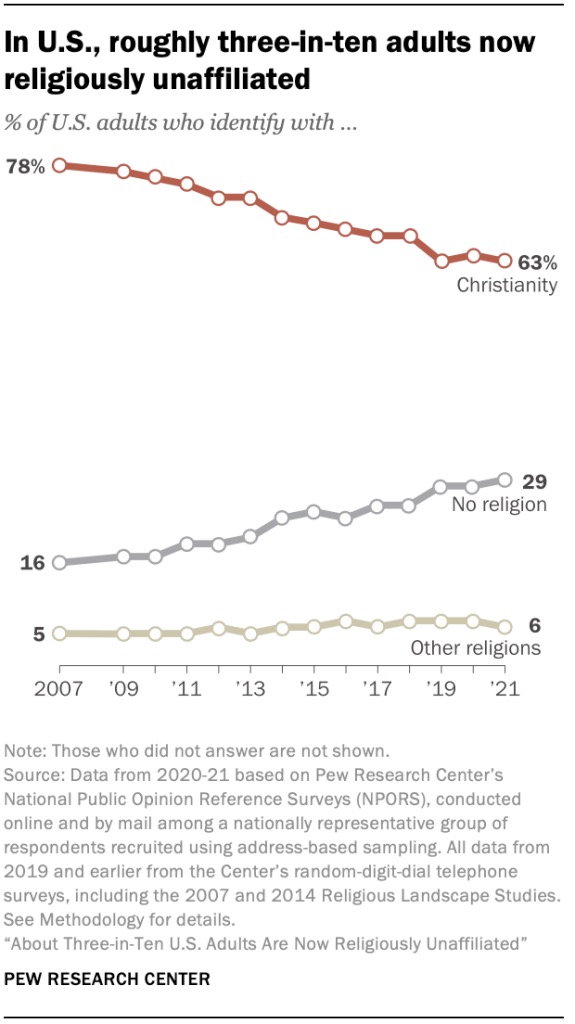
The Pew Research Center cited a steady decrease in US adults who affiliate with Christianity while those who declare “no religion” has nearly doubled in the last 15 years or so. Affiliation with other religions has remained flat over the same period. Only around 4 in 10 Americans say religion [by any faith] is “important” in their lives.
There are numerous reasons for the decline and there is certainly no simple answer. Perhaps it is indeed time for people of faith to hold their institutions accountable for how they have been caring for human beings and the planet. But I suspect, most simply vote with their feet and leave. Their doubts blame faith itself.
Doubt is what drove me to the wilderness in the first place. When I am in the community of trees and animals and wildflowers, there is no vitriol over political versions of the truth. There is no argument over interpretations of scripture with regard to changing moral and cultural circumstances. Fr. Richard Rohr said Creation was the first scripture, the first Bible written by the very hand of God. It is in a language we all can understand and it does not require translation.
Author Brian McLaren has been dealing with this phenomenon. Having just finished his book, “Faith After Doubt”, I now have a framework that provides context for what I have been observing. He explains that there are four stages of faith development. The first, Simplicity, is characterized by duality; that clear distinction between good and evil, right and wrong that is attractive to people looking for a moral code. Simplicity leads to Complexity in which the religious institutions’ idealism and structure provide a roadmap for belief. But they also create an atmosphere of exclusion – of winners and losers, us and them. The rules are important.
As one continues on the path of faith development, this is where doubt enters the picture. The rules don’t add up to what the founders of the faith had in mind. Suspicion shows up as one begins to think critically about the rules and the truth they convey. Inconsistencies appear and rules seem to contradict another. McLaren posits that the institutions are not prepared to embrace doubt, calling it out as a “sickness that needs to be cured.” This stage is appropriately called Perplexity and this, I believe, is when people of faith consider leaving. Support systems that embrace and encourage these questions and challenges are rare and people are faced with navigating the path alone if at all.
It’s important to note here that McLaren distinguishes between belief and faith. Belief involves conformity to some standard of protocol, be it intellectual, professional, ethical or moral. Faith, on the other hand is a matter of “intellect, intuition, and instinct.” The implication is that doubt is not only a part of faith, it is central to it. The tension is vital to our development as spiritual beings and we need fellowship and belonging to help guide us through it.
The fourth stage is Harmony and it’s characterized by “inclusion and transcendence.” It is where we begin to understand that we are all connected – to Creation and to each other. Traits like humility and compassion are revered and we begin to understand what true love is really all about. There is hope after doubt!
Perplexity is a vulnerable time for people of faith. Their sense of community and belonging may be threatened, even among friends and family, leaving them to fend for themselves on this path. I don’t know what the answer is. Organized religion must find it, else end up with only the extremists among their ranks.
But I do know this: The quiet solitude I find in the wilderness gives me a safe place to deal with my doubts. The trees stand in support, not in judgement. The breeze reminds me that love exists in Creation. A cool spring speaks to me of the humanity (and humility) of God as I drink the communion. And the Stillness… the presence of the Creator, lets me know that Harmony awaits and that my doubts are part of the journey. “And that has made all the difference.”

 wildsabbath.com